
BESS: the engineering behind energy storage
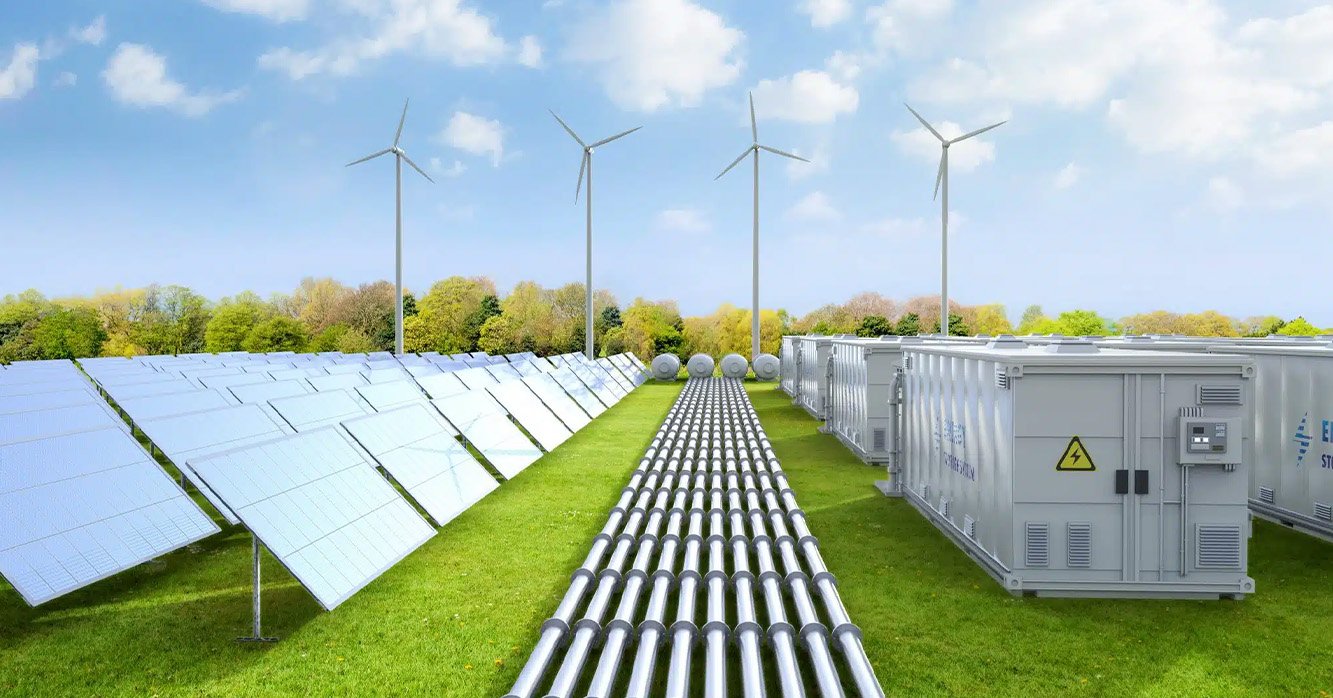
In the electrical engineering universe, the search for stability, efficiency, and energy flow control is constant. With the expansion of renewable sources and the growing complexity of industrial demands, one technology stands out as the backbone of the new energy era: the BESS (Battery Energy Storage System). But what really constitutes a BESS and how does it operate on a technical level?
This article demystifies the architecture behind this transformative solution, going beyond superficial benefits to explore its components, its operating modes, and the point where the system connects to the medium voltage grid.
The anatomy of a BESS system
A BESS is not just a set of batteries: it is a hardware and software ecosystem designed to manage energy flow with surgical precision. Its main blocks are four.
The batteries — the heart of the system
The central storage element. Currently, the predominant chemistry for large-scale stationary applications is Lithium-Ion, especially LFP (Lithium Iron Phosphate, LiFePO₄). The choice of LFP is due to its high safety, long lifespan (higher number of charge/discharge cycles), and thermal stability — critical factors for industrial and commercial environments. Individual cells are assembled into modules, which in turn are organized into racks, allowing the system's scalability to meet any energy (kWh) and power (kW) demand.
BMS — the guardian of the cells
Each battery set is supervised by a BMS (Battery Management System). It is the electronic brain responsible for ensuring the health and safety of the cells, monitoring vital parameters in real time such as voltage, current, temperature, state of charge (SoC), and state of health (SoH). The BMS protects the batteries against overcharge, deep discharge, and overheating, in addition to performing cell balancing to maximize the lifespan and efficiency of the set.
PCS — the universal translator
The PCS (Power Conversion System), or bidirectional inverter, is the bridge between the direct current (DC) world of the batteries and the alternating current (AC) world of the facility and the grid. During charging, it converts AC to DC; during discharging, it does the reverse. More than a converter, the PCS controls power quality, regulating voltage and frequency — fundamental for the stability of sensitive equipment.
EMS — the strategist
If the BMS is the guardian of the batteries, the EMS (Energy Management System) is the commander of the entire operation. This high-level software integrates data from the grid, the facility, generation sources (solar, wind), and the batteries themselves to make intelligent decisions. It is the EMS that executes the programmed strategies:
- Peak Shaving: upon detecting that the demand is approaching the limit contracted with the utility, the EMS commands the PCS to inject energy from the batteries, "flattening" the consumption peak and avoiding overruns and fines.
- Load Shifting (energy arbitrage): based on peak and off-peak tariffs, the EMS schedules charging during the cheapest energy hours and discharging during the most expensive ones, generating direct savings.
- Renewable firming: for plants with a photovoltaic power station or wind farm, the BESS absorbs the excess generation and injects it when generation ceases (at night or on windless days), "firming" the renewable source and ensuring a continuous and predictable supply.
BESS in medium voltage: where the system connects
In industrial and utility applications, the BESS rarely operates isolated in low voltage. Above a few hundred kW, the connection happens in medium voltage (15 to 36 kV), and that is where distribution engineering comes into play. Between the PCS and the delivery point, there is a chain of switching and protection equipment that needs to be correctly specified:
- Step-up transformer, to adapt the PCS output voltage to the grid level;
- Metal-clad switchgear and medium voltage circuit breakers (vacuum or SF6) for switching and sectioning the set;
- Protection relays (ANSI 50/51, 87, 27/59, 81 functions) for selective tripping in the face of faults, over/undervoltage, and frequency deviations;
- Surge arresters and terminations for surge protection and safe cable connection.
Sizing this interface is as decisive for the project's success as the choice of batteries — it is what ensures the protection of the investment and compliance with the utility.
Safety and standards
Storage systems concentrate a lot of energy in a small space, which makes safety non-negotiable. A serious project observes, among others:
- IEC 62933 — series dealing with electrical energy storage (EES) systems: terminology, unit requirements, and safety aspects;
- IEC 62619 / NBR IEC 62619 — safety of lithium cells and batteries for industrial use;
- NR-10 — safety in electrical installations and services;
- Thermal management and fire protection — rack climate control, early detection, and proper suppression, mitigating the risk of thermal runaway.
Practical applications in industry and commerce
- Energy bill reduction through peak shaving and tariff arbitrage;
- Backup and operational continuity — the BESS can act as a large-scale UPS for critical loads;
- Power quality — voltage and frequency support, reducing sags that affect sensitive equipment;
- Integration with own generation — maximum utilization of solar, wind, or biogas power plants.
Trifásica Elétrica: expertise in energy systems integration
The successful implementation of a BESS goes far beyond the simple acquisition of equipment. It requires deep knowledge in electrical engineering for the correct sizing, integration, and commissioning of the system — including the entire medium voltage interface that connects the storage to the grid.
Trifásica Elétrica positions itself as your technical partner in advanced energy projects. In addition to expertise in BESS technology, our team specializes in designing and supplying switching and protection components from 15 to 36 kV — metal-clad switchgear, circuit breakers, relays, transformers, surge arresters, and terminations — that make the installation safe and reliable. We analyze your consumption profile and goals to define the best architecture: optimizing the current operation, developing a new renewable energy plant, or integrating both technologies with the best technical and financial return.
The era of passive energy management is over. With BESS and Trifásica Elétrica's solutions, your company gains active control over its most vital resource.
Frequently asked questions
What is a BESS system?+
BESS (Battery Energy Storage System) is a battery energy storage system composed of cells (usually LFP), BMS, PCS (bidirectional inverter), and EMS, designed to store and release energy in a controlled manner.
Why is LFP the preferred chemistry in stationary BESS?+
LFP (Lithium Iron Phosphate) offers high safety, great thermal stability, and a long lifespan in charge/discharge cycles, making it ideal for large-scale industrial and commercial applications.
How does the BESS connect to the medium voltage grid?+
Above a few hundred kW, the PCS output passes through a step-up transformer and a medium voltage (15–36 kV) interface with metal-clad switchgear, circuit breakers, protection relays, surge arresters, and terminations before the delivery point.
What standards apply to a BESS project?+
Among the main ones are the IEC 62933 series (electrical energy storage systems), IEC/NBR 62619 (safety of industrial lithium batteries), and NR-10, in addition to thermal management and fire protection requirements.
Trifásica Elétrica distributes medium voltage materials throughout Brazil.
Request a quote