
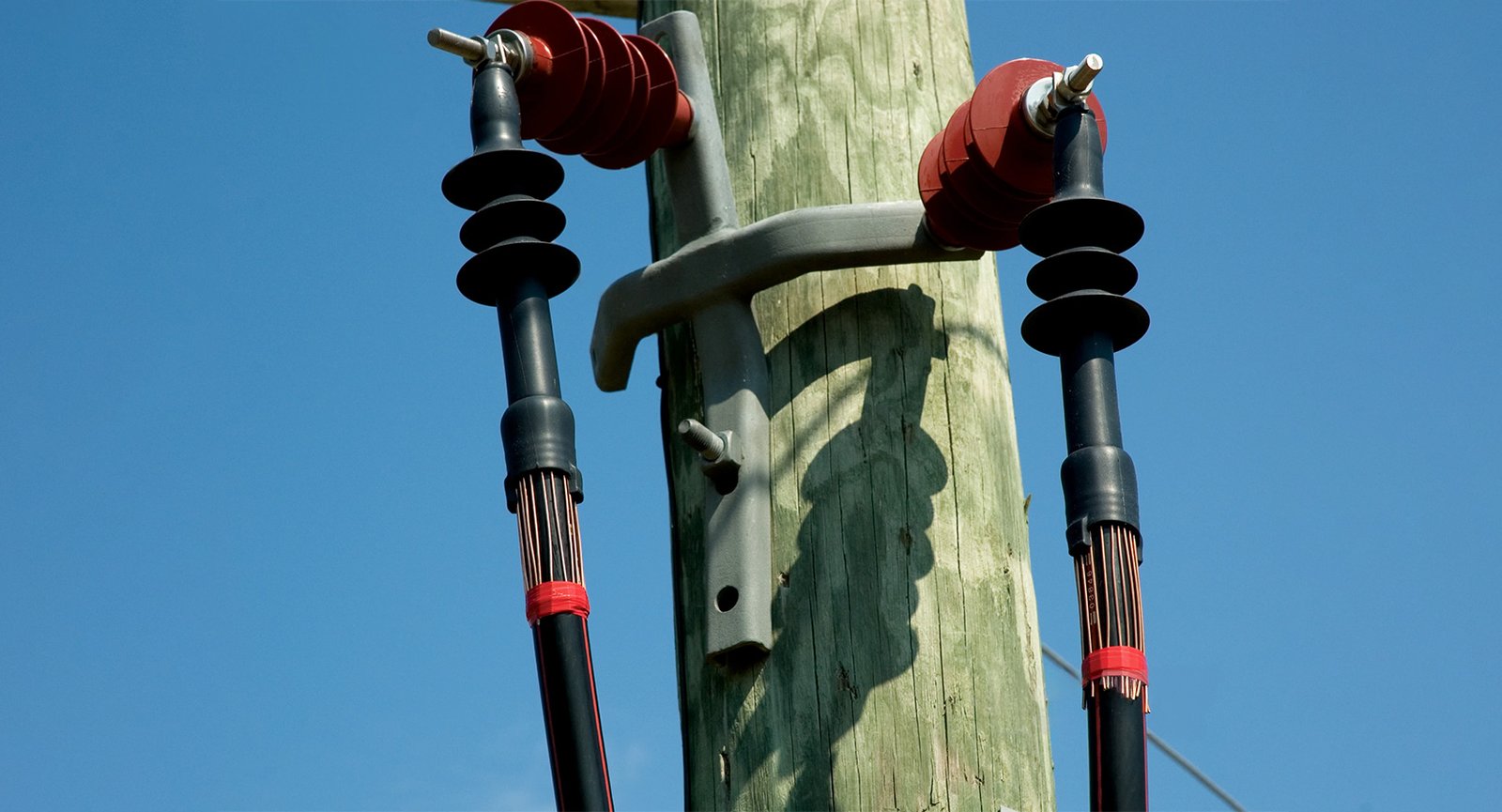
The reliability of a medium-voltage system is the backbone of any critical operation. In this scenario, the integrity of each component is fundamental, and one of the points that demands the most attention from engineering is the termination of power cables. Often underestimated, they are a critical link that, if poorly specified or installed, can compromise the entire safety and continuity of the system.
A termination, or cable sleeve, is a complex engineering device. Its primary function is to manage the transition of the cable, which has an electric field controlled by its shielding, to an unshielded environment, such as a connection to a transformer or an overhead line. Without proper control of the electric field in this transition, the dielectric stress would concentrate at the cable end, leading to partial discharges and, inevitably, a failure.
In addition to field control, the termination must provide insulation and an airtight seal against moisture and contamination. Given this responsibility, choosing the right technology is a crucial engineering decision. Let's analyze the three main solutions on the market.
Heat Shrink Terminations
Heat-shrink technology is the most traditional and widespread in the global market. Its polymeric components are designed to shrink under the application of heat, usually with a gas torch, conforming perfectly to the cable and its accessories.
- Operating Principle: The polymer crosslinking process creates a "molecular memory." When heated, the material returns to its original shape, contracting and creating a robust mechanical and dielectric seal.
- Advantages:
- High Mechanical Performance: It offers excellent resistance to abrasion and impact.
- Cost-Benefit: It generally has the lowest acquisition cost among the technologies.
- Consolidation: It is a widely known technology, mastered by experienced installers.
- Points to Note:
- Application Dependency: The final quality depends entirely on the installer's skill in applying heat evenly.
- Need for Flame: The use of a blowtorch prevents its application in areas with a risk of explosion or fire.
Cold Shrink Polymer Terminations
Representing an evolution in practicality and safety, cold-shrink technology eliminates the need for heat. The termination, usually made of silicone rubber or EPDM, comes pre-expanded over a coiled plastic core.
- Operating Principle: The installation consists of positioning the part and removing the core. The material's elastic memory causes it to contract, exerting a constant, sharp pressure on the cable.
- Advantages:
- Simplified and Quick Installation: It reduces application time and minimizes the chance of human error.
- Intrinsic Safety: The absence of an open flame makes it ideal for any environment.
- Active Sealing: Constant pressure adjusts to variations in cable diameter caused by load and temperature cycles, keeping the seal always active.
- Points to Note:
- Storage Sensitivity: The components have an expiration date that must be respected.
- Acquisition Cost: The cost of the material may exceed that of the heat-shrink technology.
Disconnectable Terminals (Separable Connectors)
This is the most advanced solution for connecting cables to equipment such as transformers and gas-insulated switchgear (GIS) cubicles. These are modular, factory-pre-tested systems that offer a superior level of safety and flexibility.
- Operating Principle: The system consists of a connector (usually elbow or "T" shaped) that is installed at the end of the cable and attaches to a standardized bushing (IEEE 386 standard) in the equipment.
- Advantages:
- "Dead-Front" Security: After connection, there are no exposed live parts, eliminating the risk of electric arc during operations.
- Modularity: It allows for quick and safe disconnection of the circuit for maintenance or testing, without the need to disassemble the termination.
- Maximum Reliability: Being factory tested, the 100% mitigates the risks associated with field installation.
- Points to Note:
- Initial Investment: It requires the highest acquisition cost.
- Interface Requirement: The equipment must be designed with compatible standard bushings.
An engineering-based decision
Selecting the ideal termination isn't simply a matter of "which is the best?", but rather "which is the most suitable for this specific application?". Factors such as the installation environment (indoor/outdoor, polluted), safety requirements (presence of gases), the need for future switching operations, and the criticality of the circuit should guide the decision.
The right choice is a technical balance between performance, safety, and total cost of ownership (TCO). A partner with in-depth technical knowledge is essential to assist in this specification, ensuring that the implemented solution guarantees maximum reliability and longevity for the medium-voltage system.
In the Three-phase electrical, We understand that every detail of your medium-voltage infrastructure directly impacts the safety, efficiency, and continuity of your operation. Therefore, we deliver accurate technical specifications based on applied engineering and the realities of your project.
If you're looking for reliability, performance, and safety when choosing medium-voltage terminations and accessories, rely on the experts.
Speak with our engineers and discover the ideal solution for your system.
Contact our sales team on one of our channels.Follow our social media: Facebook, Instagram, LinkedIn and YouTube.