
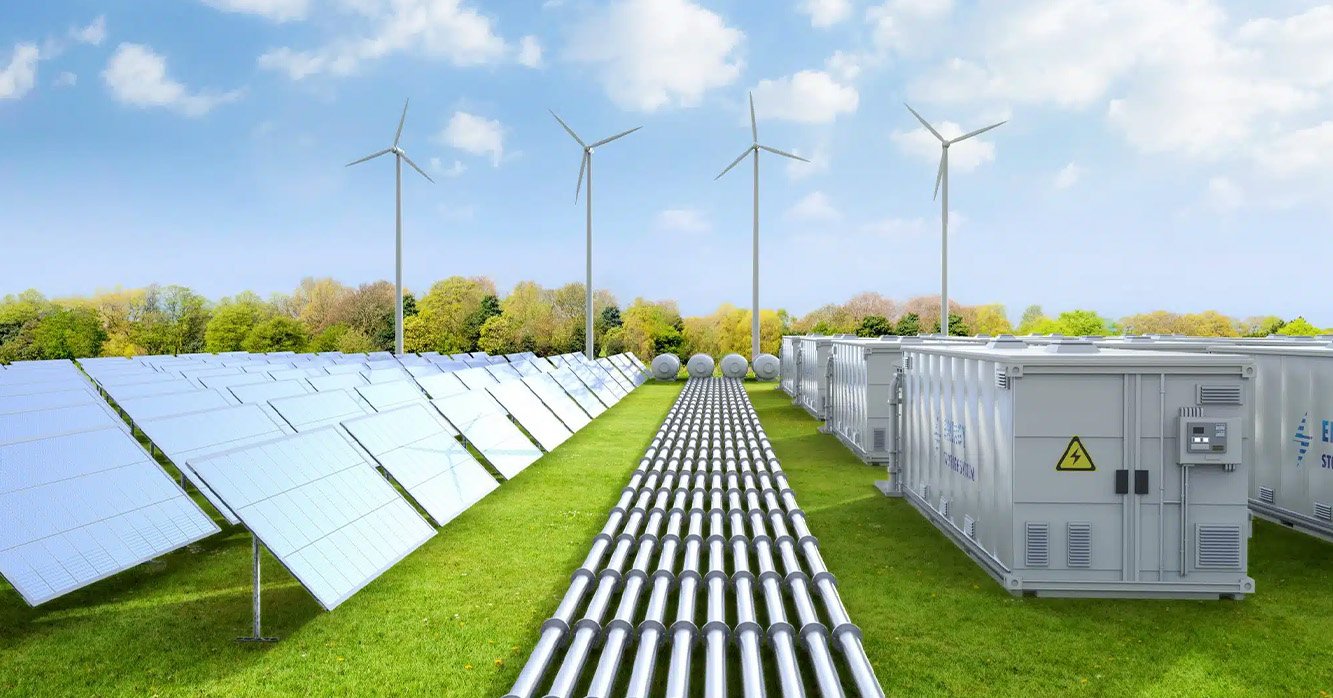
In the world of electrical engineering, the pursuit of stability, efficiency, and control of energy flow is constant. With the expansion of renewable sources and the increasing complexity of industrial demands, one technology stands out as the backbone of the new energy era: BESS (Battery Energy Storage System). But what exactly constitutes a BESS and how does it operate on a technical level?
This article demystifies the architecture behind this transformative solution, going beyond superficial benefits to explore its components and modes of operation.
The Anatomy of a BESS System
A BESS is not just a set of batteries; it's a hardware and software ecosystem designed to manage energy flow with surgical precision. Its main components are:
- The Heart of the System: The Batteries The central element of storage. Currently, the predominant chemistry for large-scale stationary applications is... Lithium-ion, especially the LFP (Lithium Iron Phosphate). The choice of LFP is due to its high safety, long service life (greater number of charge/discharge cycles) and thermal stability, critical factors for industrial and commercial environments. The individual cells are assembled into modules, which in turn are organized in racks, allowing the system to be scalable to meet any energy (kWh) and power (kW) demand.
- The Guardian: BMS (Battery Management System) Each battery pack is monitored by a BMS. This is the electronic brain responsible for ensuring the health and safety of the cells. It monitors vital parameters in real time such as... voltage, current, temperature, state of charge (SoC), and state of health (SoH). The BMS protects batteries against overcharging, deep discharge, and overheating, as well as balancing the cells to maximize the lifespan and efficiency of the battery pack.
- The Universal Translator: PCS (Power Conversion System) The PCV, or bidirectional inverter, is the bridge between the direct current (DC) world of the batteries and the alternating current (AC) world of your installation and the electrical grid. During charging, it converts AC to DC. During discharging, it does the reverse. More than just a simple converter, the PCV is responsible for controlling power quality by regulating... voltage and frequency, which is fundamental for the stability of sensitive equipment.
- The Strategist: EMS (Energy Management System) If the BMS is the guardian of the batteries, the EMS is the commander of the entire operation. This high-level software integrates data from the grid, the installation, the generation sources (such as solar panels or wind turbines), and the batteries themselves to make intelligent decisions. It is the EMS that executes the programmed strategies, such as:
- Peak Shaving The EMS monitors the plant's demand. When it detects that demand is approaching the limit contracted with the utility company, it commands the PCS to inject energy from the batteries, "flattening" the peak consumption and avoiding penalties.
- Load Shifting (Energy Arbitrage): Based on energy tariffs (peak and off-peak hours), EMS schedules BESS charging during the cheapest energy hours and unloading during the most expensive hours, generating direct savings.
- Renewable Firming: For a company with photovoltaic power plant or wind, Intermittency is a challenge. The BESS, managed by EMS, absorbs surplus generation and injects it into the internal grid when generation ceases (e.g., at night or on windless days), "securing" the renewable source and guaranteeing a continuous and predictable supply.
Three-phase Electrical: Expertise in Energy System Integration
The successful implementation of a BESS goes far beyond simply acquiring equipment. It requires in-depth knowledge of electrical engineering for the correct sizing, integration, and commissioning of the system.
THE Three-phase electrical We position ourselves as your technical partner in advanced energy projects. In addition to deep expertise in BESS technology, our team specializes in designing and implementing complete solutions for... photovoltaic plants, wind farms and systems with biogas generators. We analyze your consumption profile and goals to define the best architecture: whether it's implementing a BESS system to optimize your current operation, developing a new renewable energy plant, or intelligently integrating the two technologies to ensure maximum efficiency and the best technical and financial return.
The era of passive energy management is over. With BESS and Trifásica Elétrica's solutions, your company gains active control over its most vital resource.
Contact our sales team on one of our channels.Follow our social media: Facebook, Instagram, LinkedIn and YouTube.